
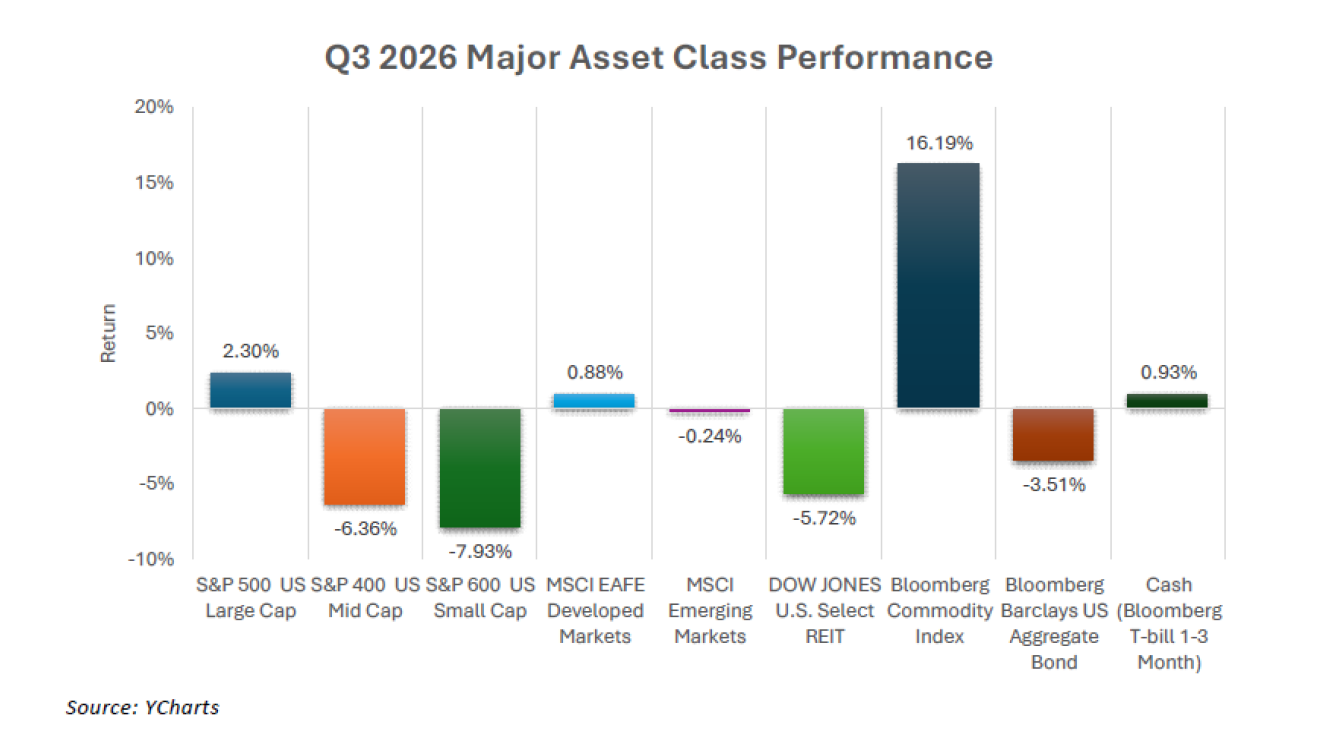
- Markets took a pause during the third quarter after the fantastic second quarter rally. Of thenine major asset classes examined, only Commodities and US Large Cap equities outperformed cash. The S&P 500 gained 2.3% during the quarter and finished near record highs but leadership within the index narrowed. US mid- and small-caps fell 6.4% and 7.9% respectively.
- The US–Iran ceasefire framework signed in June unraveled weeks later, leaving the Strait of Hormuz largely closed. Brent crude prices soared back into triple-digit territory and Commodities were the strongest returning asset class after severely lagging last quarter.
- The Federal Reserve raised interest rates in September for the first time since 2023 and signaled another hike before year-end. Treasury yields spiked to their highest levels in two decades, triggering a fall of 3.5% in bonds.
- Corporate earnings remain the market's north star. S&P 500 earnings are expected to grow nearly 30% in the third quarter and this quarter’s muted returns brought valuations back below their five-year averages.
Market Returns
After one of the strongest quarters in recent memory in the second quarter, markets spent the third quarter digesting a continued energy shock and the first Federal Reserve rate hike in more than three years. On the bright side, every major equity asset class remains up roughly 10% or more year-to-date. The S&P 500 gained 2.3% and finished the quarter close to its record high. US mid-cap stocks fell 6.4% and small-caps fell 7.9% as higher borrowing costs weighed on smaller, more rate-sensitive companies. The equal-weight S&P 500 declined 1.9% and the Dow Jones Industrial Average fell 2.7%. A small group of mega-cap technology companies was responsible for all of the S&P 500's gain, a theme examined in more detail below.
International markets were little changed. Developed international equities, as measured by MSCI EAFE, rose 0.9% while emerging markets slipped 0.2%. South Korea, last quarter's standout, fell nearly 10% as memory-chip and semiconductor stocks cooled.
Commodities were the top-performing asset class by a wide margin, gaining 16.2%, as oil prices surged on the breakdown of the US–Iran ceasefire framework. Real estate fell 5.7% as rising interest rates pressured the asset class. We remain underweight commodities and real estate.
Bonds, as measured by the Bloomberg Barclays US Aggregate Bond Index, fell 3.5%, the index's weakest quarter since 2022. Bond performance suffered as Treasury yields climbed to their highest levels in roughly two decades. Starting yields remain high.
Ceasefire Unravels and Oil Returns to $100
Last quarter we cautioned that the Middle East was experiencing de-escalation but a resolution was still outstanding. The memorandum of understanding signed by the US and Iran on June 17 began to fray within weeks. In early July, attacks on commercial vessels in the Strait of Hormuz prompted US strikes on Iran and Washington revoked a sanctions waiver on Iranian oil sales. Negotiations stalled in August when Tehran tied the reopening of the strait to sanctions relief and war reparations. September brought a new round of tit-for-tat attacks on tankers and military targets and the quarter ended without progress.
Shipping through the strait has not recovered. Daily transits ran at roughly 10 vessels in early September compared with about 130 before the war. Brent crude, which began the quarter in the low $70s, ran to $100 per barrel in late July before ending the quarter near $103, a gain of roughly 42%. The consequences of triple-digit oil have touched many areas of the economy. Most prominently, the national average price of a gallon of gas was around $4.50 (and diesel at a $6 all-time high) throughout the peak driving season. Pain at the pump was one key factor contributing to a 12-year low in consumer confidence.
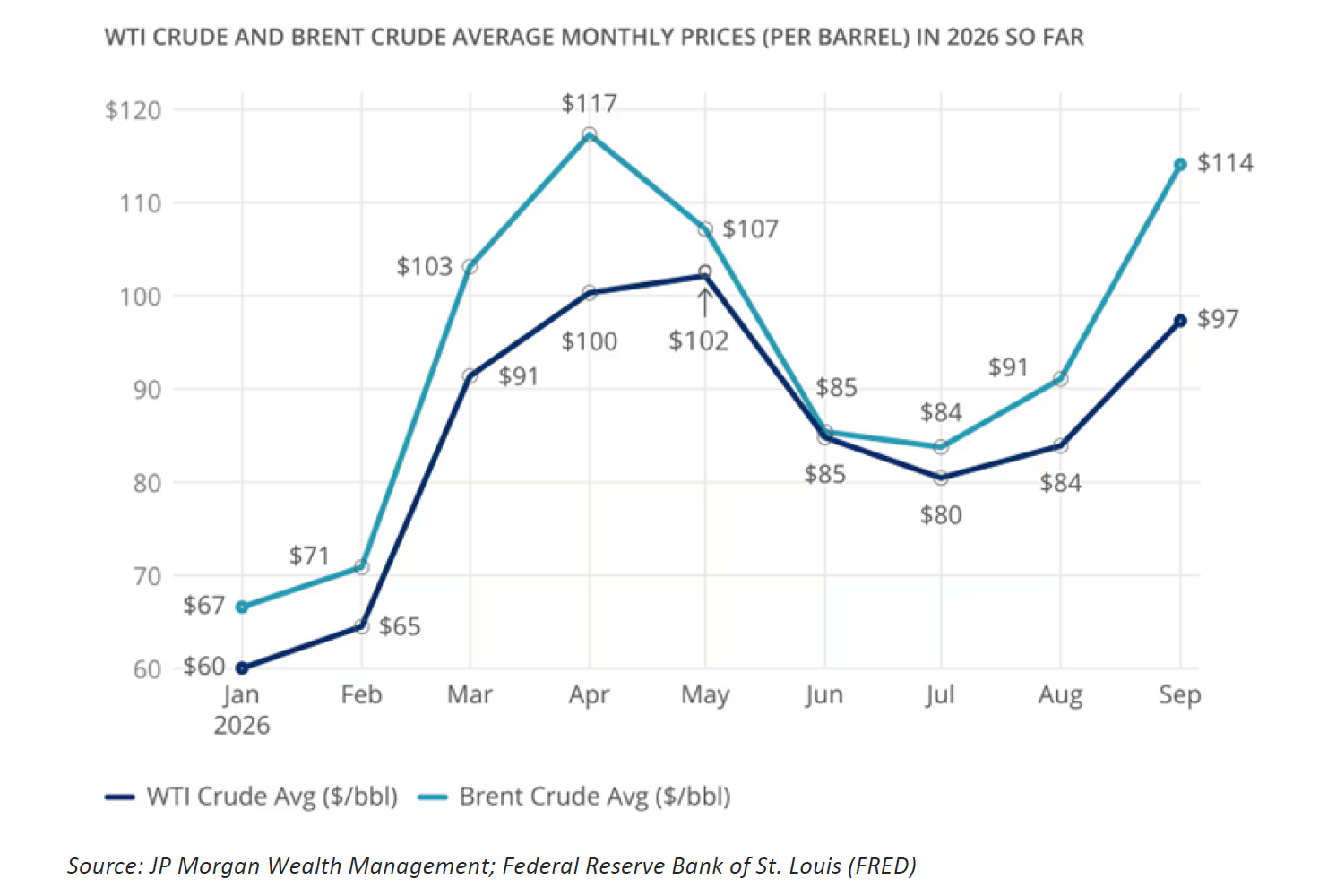
There were constructive developments late in the quarter. Gulf crude exports outside of Iran have recovered to near pre-war levels and the US and Iran were engaged in indirect talks over a short-term ceasefire as the quarter closed (and midterms near). Energy prices remain a crucial swing factor for inflation and interest rates through year-end.
A Fed Hike and Soaring Yields
Fed Chair Kevin Warsh's hawkish debut comments in the second quarter resulted in action in the third. After holding steady in July, the Federal Open Market Committee voted unanimously on September 16 to raise the federal funds rate by a quarter point to 3.75%–4.00%. It was the Fed's first rate increase since July 2023.
Warsh was direct about the reasoning, stating that "inflation is too high and has been for too long." Consumer prices rose 3.4% over the twelve months through August. That is an improvement from 4.2% in May but still well above the Fed's 2% target and the renewed climb in energy prices threatens further progress. Sixteen of eighteen officials expect at least one more hike this year.
The bond market reaction was severe. The 10-year Treasury yield rose nearly nine-tenths of a percentage point to end the quarter at 5.29%, and the 30-year reached 5.63%, its highest level since 2002. The average 30-year mortgage rate has climbed to 7.49% as of this writing and is expected to negatively impact real estate prices.
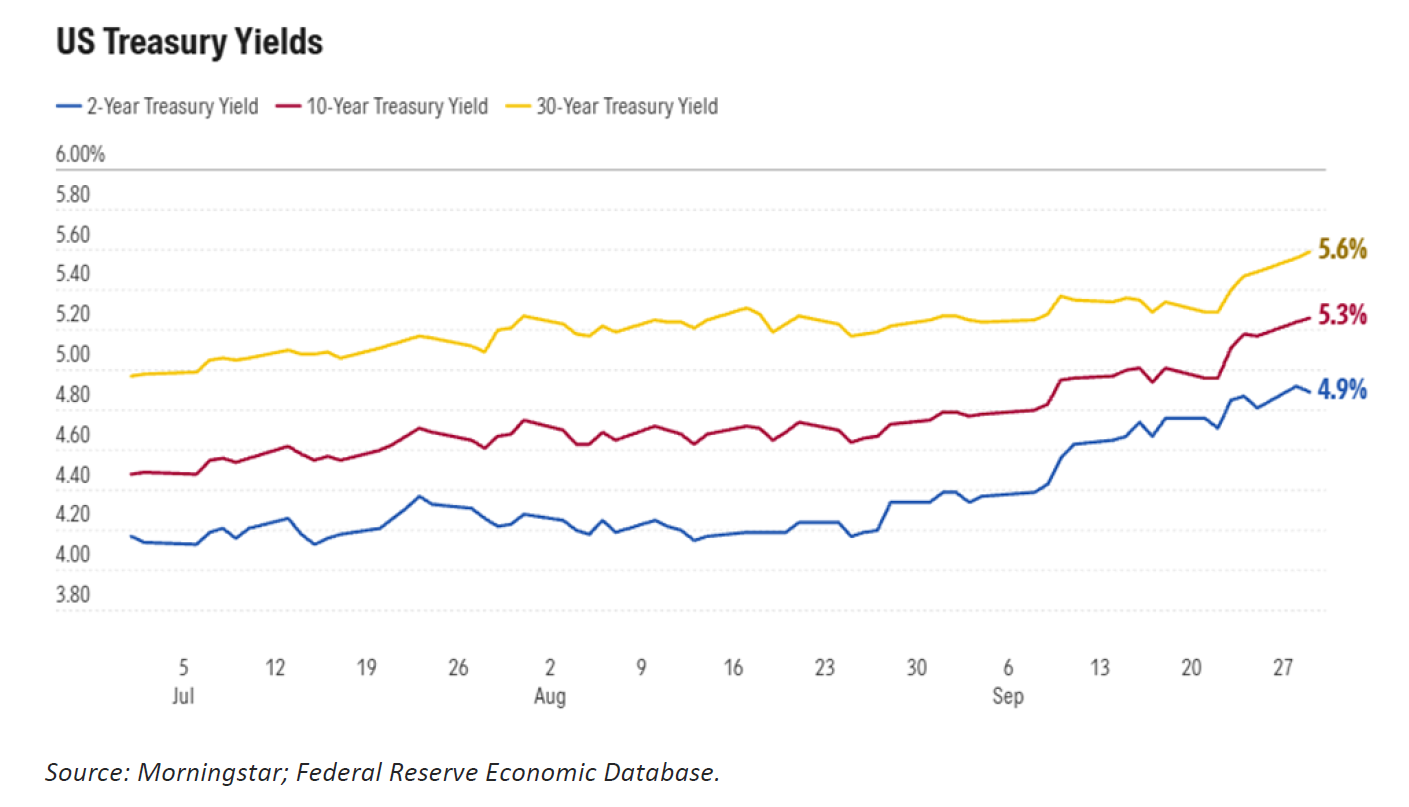
Rising yields mean falling bond prices and the Aggregate Bond Index's 3.5% decline erased its gains for the year. We are currently executing broad-based tax loss harvesting trades in our bond positions. Post selloff, the forward math for bonds has improved considerably. High-quality bonds now offer starting yields above 5%, among the highest investors have seen since before the 2008 financial crisis. We remain confident that bonds play a crucial role in client portfolios, offering high income and diversification benefits.
Narrow Market Breadth and AI Trade Update
Only four of eleven sectors in the S&P 500 outperformed the index, signaling a narrow swath of leadership in the market driven mainly from Energy and Technology.
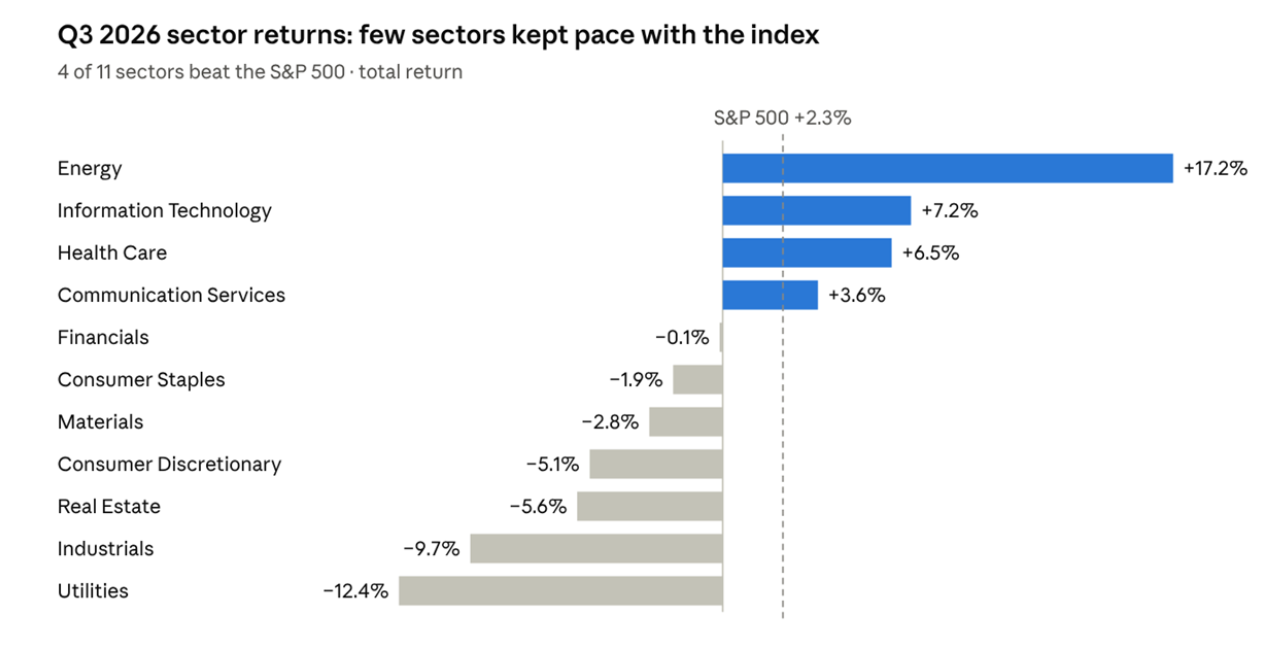
Source: S&P Dow Jones Indices. S&P 500 sector total returns, quarter ended September 30, 2026.
Rate-sensitive areas bore the brunt of rising yields. Utilities, industrials, and real estate were the weakest sectors, and housing-related stocks were hit especially hard.
At the other end of the spectrum, five companies (Microsoft, NVIDIA, Apple, Meta, and Palantir) accounted for more than the entire return of the S&P 500 during the quarter. Technology now represents nearly 40% of the index, up from about 34% at the start of the year.
Tech stock fundamentals remain strong due to strong revenue and earnings but investors have grown more discerning than they were over the past one to two years. The AI buildout is intact, but the market is increasingly separating the companies converting historical levels of capital expenditures into profits from those with tertiary exposure to the theme.
Outlook
We enter the fourth quarter with a balanced view of markets and portfolios. There is a good deal to be encouraged by. Analysts expect S&P 500 earnings to grow 29.5% in the third quarter and estimates rose during the quarter. Profits have grown faster than stock prices, helping to ease valuation multiples, and the AI investment cycle remains firmly in place. The labor market remains strong and the consumer, especially in the higher net worth ranges, is healthy.
The risks are equally clear. Oil near $100 and a Fed that is raising rates are a difficult combination for smaller companies, real estate, and lower end consumers more directly impacted by food and energy cost increases.
Quarters like this one are the reason we build portfolios around long-term goals rather than short-term momentum. Staying diversified and disciplined allowed our portfolios to weather the first and third quarter's volatility and participate in the second quarter's recovery and we believe our models are well positioned for the future.
Thank you for your continued trust. Please don't hesitate to reach out with any questions as we head into year-end.
Kyle Matthews, CFA on behalf of Miller Financial Services and OnePoint BFG Wealth Partners
DISCLAIMER
Investment advisory and financial planning services offered through Bleakley Financial Group, LLC, an SEC registered investment adviser, doing business as OnePoint BFG Wealth Partners and Miller Financial Services.
The opinions voiced in this material are for general information only and are not intended to provide specific advice or recommendations for any individual. The market and economic data is historical and is no guarantee of future results. All indices are unmanaged and may not be invested into directly. The information in this report has been prepared from data believed to be reliable, but no representation is being made as to its accuracy and completeness.
Any company names noted herein are for educational purposes only and not an indication of trading intent or a solicitation of their products or services.
Nothing in this material should be construed as investment advice offered by OnePoint BFG Wealth Partners or Miller Financial Services. This market update is for informational purposes only and is not meant to constitute a recommendation of any particular investment, security, portfolio of securities, transaction or investment strategy. No chart, graph, or other figure provided should be used to determine which securities to buy, sell or hold. No representation is made concerning the appropriateness of any particular investment, security, portfolio of securities, transaction or investment strategy. You should speak with your own financial professional before making any investment decisions.
Past performance is not indicative of future results. Neither OnePoint BFG Wealth Partners nor Miller Financial Services guarantee any specific outcome or profit. These disclosures cannot and do not list every conceivable factor that may affect the results of any investment or investment strategy. Risks will arise, and an investor must be willing and able to accept those risks, including the loss of principal.
Certain statements contained herein are statements of future expectations and other forward-looking statements that are based on opinions and assumptions that involve known and unknown risks and uncertainties that would cause actual results, performance or events to differ materially from those expressed or implied in such statements.
The economic forecasts set forth in this material may not develop as predicted and there can be no guarantee that strategies promoted will be successful. The fast price swings in commodities and currencies will result in significant volatility in an investor’s holdings. International investing involves special risks such as currency fluctuation and political instability and may not be suitable for all investors. These risks are often heightened for investments in emerging markets. The fast price swings in commodities and currencies will result in significant volatility in an investor’s holdings.
OnePoint BFG Wealth Partners (“OnePoint BFG”) often uses Artificial Intelligence (“AI”) in the generation of reports such as the above. OnePoint BFG and its employees are bound by all applicable Firm policies and procedures when using AI. AI is subject to risks and limitations. OnePoint BFG has established policies and procedures to ensure all AI generated material goes through human review prior to dissemination. For additional information regarding AI, please refer to One Point BFG’s ADV 2A.
OP 26-0988