


Over the last two years, gold, silver, and other precious metals have increased in value significantly, drawing the attention of many investors. Gold recently went above $4,700 per ounce, and silver is now trading above $90 per ounce. These are record-breaking prices for both metals. Because of these strong gains, some investors may be wondering if they should buy these assets. Like any investment, it's helpful to look at the bigger picture to understand their history and role in a well-balanced investment portfolio.
Many investors think of precious metals as "safe haven" investments—meaning they protect your money during uncertain times. However, these metals and other commodities (raw materials like oil or wheat) can go through extreme ups and downs in price. Right now, gold and silver are rising along with many other types of investments because of uncertainty about government policies on spending, interest rates, and global tensions. It's best to think of these assets as part of a complete investment plan that matches your financial goals, rather than as a way to make quick profits.
Precious metals often increase in value during uncertain times
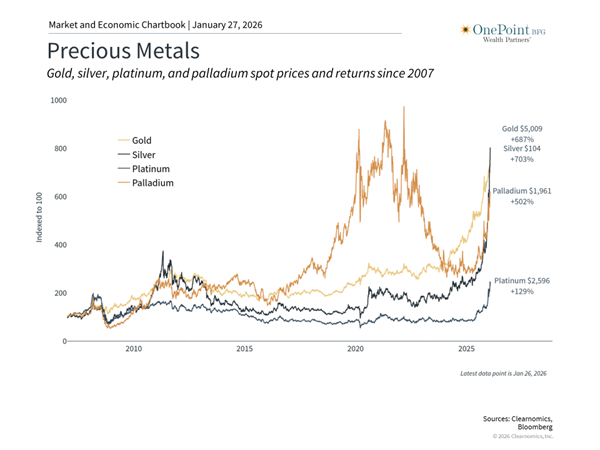
Several things have caused gold and silver prices to jump recently. One major factor has been disagreements between the White House and the Federal Reserve (the Fed), which is America's central bank. This has raised concerns about whether the Fed can make independent decisions and what might happen with interest rates, especially since Jerome Powell's term as Fed chair ends in May 2026. When interest rates go down and inflation (rising prices) might go up, the dollar often loses value. This naturally leads some investors to look for assets that can hold their value over time.
Another important factor is that central banks (government institutions that manage a country's money supply) worldwide have been buying gold regularly in recent years. They're moving away from holding U.S. dollars as their main reserve. Central banks need reserves to manage their monetary policy (how they control money supply and interest rates) and keep their currencies stable. These purchases of gold and other assets have increased because of global tensions and worries about currency stability.
Both metals also benefit from their uses in manufacturing, such as in electric vehicles, solar panels, and artificial intelligence equipment. So they serve multiple purposes: as precious metals, as investments during uncertain times, and as materials used in industry.
It's hard to predict when precious metals will increase in value
Throughout history, precious metals have often performed well during periods of uncertainty about monetary policy (how governments and central banks manage money and interest rates). In the 1970s, for example, both gold and silver prices rose dramatically when the economy experienced stagflation (high inflation combined with slow economic growth), reaching their peak around 1980. Similarly, both rose from 2008 to 2011 during the financial crisis, and again during the 2020 pandemic.
In each of these situations, investors bought precious metals when uncertainty about monetary policy and economic conditions was highest. However, both gold and silver prices started to fall soon after conditions began to improve.
This creates at least two problems for investors who want to buy these investments based on their recent strong performance. First, trying to predict gold and silver prices means trying to predict interest rates, inflation, and other complex economic factors. As we've seen in recent years, these factors are very difficult to predict accurately. Many concerns that investors and economists had when inflation rose sharply in 2021 and 2022 didn't actually happen as expected.
Second, while it makes sense that investors are attracted to investments that have done well recently, history shows that it's very difficult to know when precious metals will rise or fall. For instance, the 1970s gold rally was followed by twenty years of falling prices. Gold reached above $800 in 1980, and it didn't reach that level again until 2007.
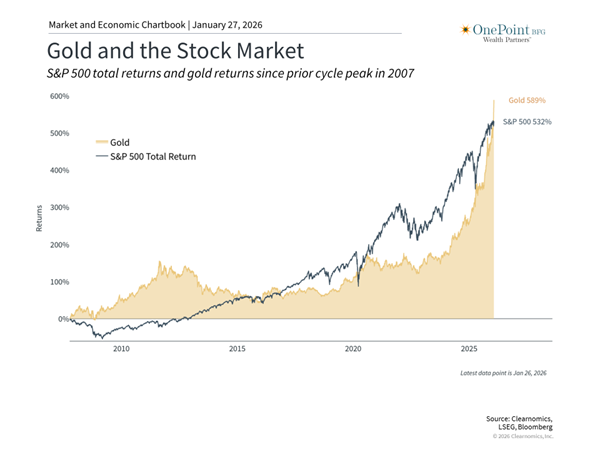
The chart shows how gold has performed compared to the S&P 500 (a measure of the overall stock market) since the 2007 market peak. While gold has had periods of strong gains, the stock market has also done well over these time periods. For investors focused on the recent precious metals rallies, this longer-term view might be surprising. However, it makes sense because the stock market has historically gone up over long time periods.
This pattern also applies to silver. Despite strong demand from industries, silver has experienced long periods of poor performance between rallies. For example, silver had a strong rally in the late 1970s. During that time, the Hunt brothers (wealthy investors) tried to control the market by buying large amounts of silver and futures contracts (agreements to buy at a future date). While they drove prices higher temporarily, prices eventually crashed when new supply came to market and regulators introduced limits on buying commodities with borrowed money.
Other precious metals show similar behavior. Between 2016 and early 2022, palladium (another precious metal) gained over 500%. This increase was driven by limited global supply and greater use in products like catalytic converters for cars. However, after reaching its peak, prices fell sharply over two years.
Precious metals should fit with your financial goals
These examples show that when it makes sense for investors to own precious metals and commodities, gold and silver are best thought of as parts of a broader commodities allocation (portion of your portfolio) or as alternative investments (investments beyond traditional stocks and bonds). The Bloomberg Commodity Index, for instance, currently puts 14.9% in gold and 3.9% in silver, along with other commodities such as industrial metals, energy, and agricultural products. This diversified (spread out) approach to commodities helps manage the ups and downs that come with any single commodity.
The reason for including precious metals in portfolios is that they behave differently from stocks and bonds. Their value comes from being rare, serving as stores of value (holding worth over time), and having industrial uses. This means they often react differently to market and economic events than traditional investments, which can help stabilize portfolios.
However, precious metals also have important drawbacks. Most notably, they don't generate income, unlike bonds or dividend-paying stocks (stocks that pay you regular cash payments). This lack of income also makes these assets hard to value, which is another reason they experience extreme price swings. A portfolio that has too much invested in gold and silver may miss out on the long-term growth potential of stocks and the income from bonds. So even if precious metals might help during specific market conditions, they may not align with your long-term financial goals.
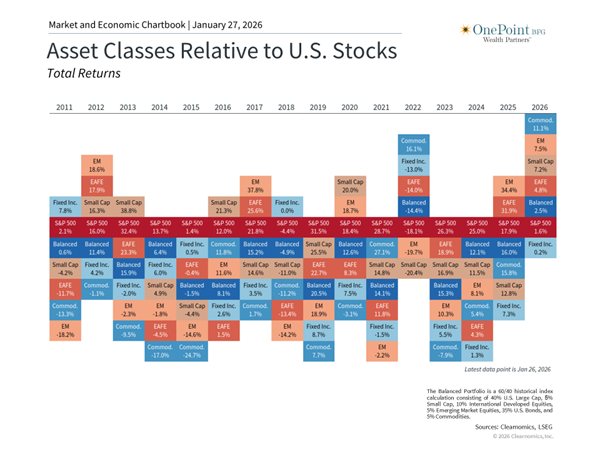
The chart shows that many types of investments have contributed to portfolio returns recently, not just precious metals. While gold and silver have certainly done well, there will always be individual investments that perform strongly during particular time periods. The key is building portfolios that can benefit from various market conditions rather than putting too much money into recent winners.
The bottom line?
Gold and silver have experienced strong gains over the past two years, but long-term investors should view them as part of their overall portfolio. Their value comes not from recent performance, but from how they help balance your portfolio across different market conditions.
If you’re considering how precious metals fit within a diversified, long-term strategy, we’re happy to help you think through the trade-offs and implications.

Investment advisory and financial planning services offered through Bleakley Financial Group, LLC, an SEC registered investment adviser, doing business as OnePoint BFG Wealth Partners (herein referred to as “OnePoint BFG”).
The opinions voiced in this material are for general information only and are not intended to provide specific advice or recommendations for any individual. The market and economic data is historical and is no guarantee of future results. All indices are unmanaged and may not be invested into directly. The information in this report has been prepared from data believed to be reliable, but no representation is being made as to its accuracy and completeness.
This commentary is for informational purposes only and is not meant to constitute a recommendation of any particular investment, security, portfolio of securities, transaction or investment strategy. No chart, graph, or other figure provided should be used to determine which securities to buy, sell or hold. No representation is made concerning the appropriateness of any particular investment, security, portfolio of securities, transaction or investment strategy. You should speak with your own financial professional before making any investment decisions.
Past performance is not indicative of future results. OnePoint BFG does not guarantee any specific outcome or profit. These disclosures cannot and do not list every conceivable factor that may affect the results of any investment or investment strategy. Risks will arise, and an investor must be willing and able to accept those risks, including the loss of principal.
Certain statements contained herein are statements of future expectations and other forward looking statements that are based on opinions and assumptions that involve known and unknown risks and uncertainties that would cause actual results, performance or events to differ materially from those expressed or implied in such statements.
The economic forecasts set forth in this material may not develop as predicted and there can be no guarantee that strategies promoted will be successful. The fast price swings in commodities and currencies will result in significant volatility in an investor’s holdings. International investing involves special risks such as currency fluctuation and political instability and may not be suitable for all investors. These risks are often heightened for investments in emerging markets. The fast price swings in commodities and currencies will result in significant volatility in an investor’s holdings.
Advisors associated with OnePoint BFG may be: (1) registered representatives with, and securities offered through Purshe Kaplan Sterling Investments (“PKS”), Member FINRA/SIPC, (2) registered representatives with, and securities offered through PKS, Member FINRA/SIPC and investment advisor representatives of OnePoint BFG; or (3) solely investment advisor representatives of OnePoint BFG, and not affiliated with PKS. Investment advice offered through OnePoint BFG, a registered investment advisor and separate entity from PKS.
Copyright (c) 2026 Clearnomics, Inc. All rights reserved. The information contained herein has been obtained from sources believed to be reliable, but is not necessarily complete and its accuracy cannot be guaranteed. No representation or warranty, express or implied, is made as to the fairness, accuracy, completeness, or correctness of the information and opinions contained herein. The views and the other information provided are subject to change without notice. All reports posted on or via www.clearnomics.com or any affiliated websites, applications, or services are issued without regard to the specific investment objectives, financial situation, or particular needs of any specific recipient and are not to be construed as a solicitation or an offer to buy or sell any securities or related financial instruments. Past performance is not necessarily a guide to future results. Company fundamentals and earnings may be mentioned occasionally, but should not be construed as a recommendation to buy, sell, or hold the company's stock. Predictions, forecasts, and estimates for any and all markets should not be construed as recommendations to buy, sell, or hold any security--including mutual funds, futures contracts, and exchange traded funds, or any similar instruments. The text, images, and other materials contained or displayed in this report are proprietary to Clearnomics, Inc. and constitute valuable intellectual property. All unauthorized reproduction or other use of material from Clearnomics, Inc. shall be deemed willful infringement(s) of this copyright and other proprietary and intellectual property rights, including but not limited to, rights of privacy. Clearnomics, Inc. expressly reserves all rights in connection with its intellectual property, including without limitation the right to block the transfer of its products and services and/or to track usage thereof, through electronic tracking technology, and all other lawful means, now known or hereafter devised. Clearnomics, Inc. reserves the right, without further notice, to pursue to the fullest extent allowed by the law any and all criminal and civil remedies for the violation of its rights.
OP 26-0110