


The first quarter of 2026 serves as a powerful reminder of why preparation and sound financial planning are essential. Following robust gains in 2025, markets confronted a convergence of geopolitical disruptions, surging oil prices, and renewed economic uncertainty. The outbreak of conflict in Iran at the end of February quickly emerged as the defining market story of the quarter, driving oil prices sharply higher and triggering the year’s first notable market pullback. By the close of March, however, early signs of a potential ceasefire began to surface, and the situation remains fluid.
Stepping back to view the broader picture, markets have continued to deliver strong performance over the trailing twelve months. Under the surface, several market segments — including energy and defensive sectors — have provided meaningful support to diversified portfolios. Looking ahead, new questions are likely to emerge, including a leadership transition at the Federal Reserve and the midterm elections later this year.
For long-term investors, the events of the first quarter reinforce a timeless truth: markets rarely advance in a straight line, and the principles of disciplined investing matter most precisely when uncertainty is highest.
Key Market and Economic Highlights
• The S&P 500 posted a total return of -4.3% in Q1, the Nasdaq -7.0%, and the Dow Jones Industrial Average -3.2%.
• The Bloomberg U.S. Aggregate Bond Index was essentially flat for the first quarter of 2026. The 10-year Treasury yield closed the quarter at 4.3%, having dipped as low as 3.9% at the end of February.
• Developed market international equities (MSCI EAFE) declined -1.1% and emerging market stocks (MSCI EM) fell -0.1% over the quarter, both on a total return basis measured in U.S. dollar terms.
• Oil prices surged, with Brent crude reaching $118 per barrel at the end of March after starting the year below $61. WTI ended the quarter at $101 per barrel.
• Gold finished the quarter at $4,668 per ounce, having climbed as high as $5,417 in January. The U.S. Dollar Index (DXY) edged modestly higher to 99.96 over the same period.
• February inflation data showed headline CPI rising 2.4% year-over-year and core CPI increasing 2.5%. The core PCE price index, the Federal Reserve’s preferred inflation gauge, rose 3.1% year-over-year in January.
• The Federal Reserve held interest rates steady in a range of 3.50% to 3.75% at both of its meetings during the first quarter.
The year’s first market pullback arrived in Q1
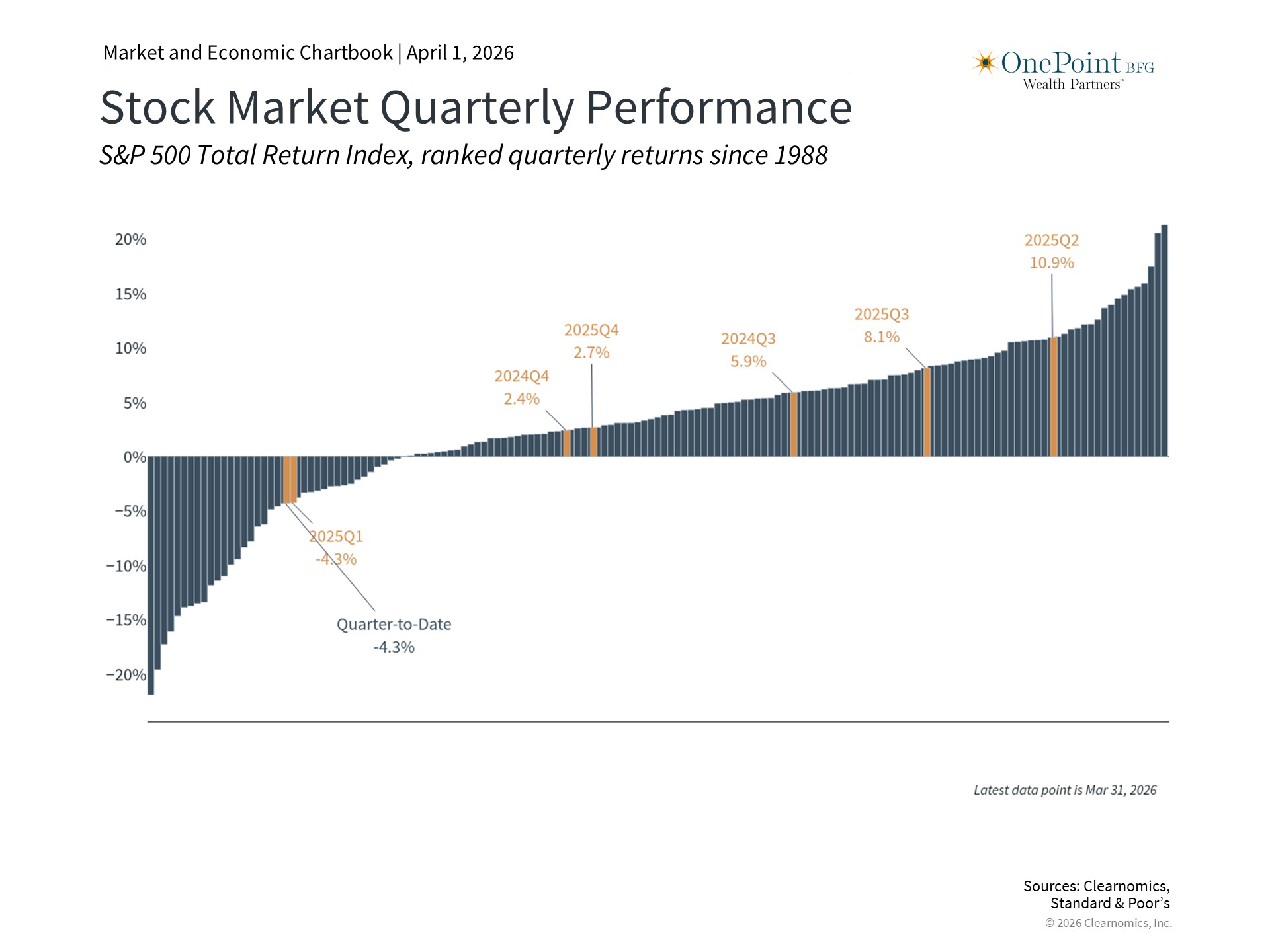
It is natural to draw comparisons between the opening months of this year and the start of 2025, as both periods were shaped by global concerns. Notably, both first quarters saw the S&P 500 pull back by exactly 4.3%. While last year’s volatility stemmed from tariffs and this year’s reflects the conflict in the Middle East, the effect on investor sentiment has been broadly similar. As uncertainty rises, markets tend to react in the short term to evolving headlines.
Past performance is never a guarantee of future results, but a longer-term lens can offer valuable historical context. Despite the turbulence in Q1 2025, equity markets went on to achieve strong gains for the remainder of the year, including dozens of record highs across major indices. The key point is not that markets always rebound quickly, but rather that market narratives tend to concentrate on negative news — which means that recoveries often arrive when investors least anticipate them.
Perhaps the most grounding perspective is recognizing that pullbacks are a normal and unavoidable feature of investing. Since 1980, the S&P 500 has experienced an average intra-year drawdown of approximately 15%, even though markets have delivered positive annual returns in more than two-thirds of years. In a typical year, investors should expect four or five pullbacks of five percent or more. Last year saw six such pullbacks, yet the S&P 500 still finished the year with an 18% total return.
For investors, the core lesson is that short-term market fluctuations — particularly those driven by headline risk — are simply part of the investment cycle. Portfolios that are aligned with long-term financial goals are specifically designed to navigate these periods. This perspective may be especially relevant as midterm elections approach and fiscal concerns resurface later in the year.
Geopolitical tensions and oil prices are driving near-term uncertainty
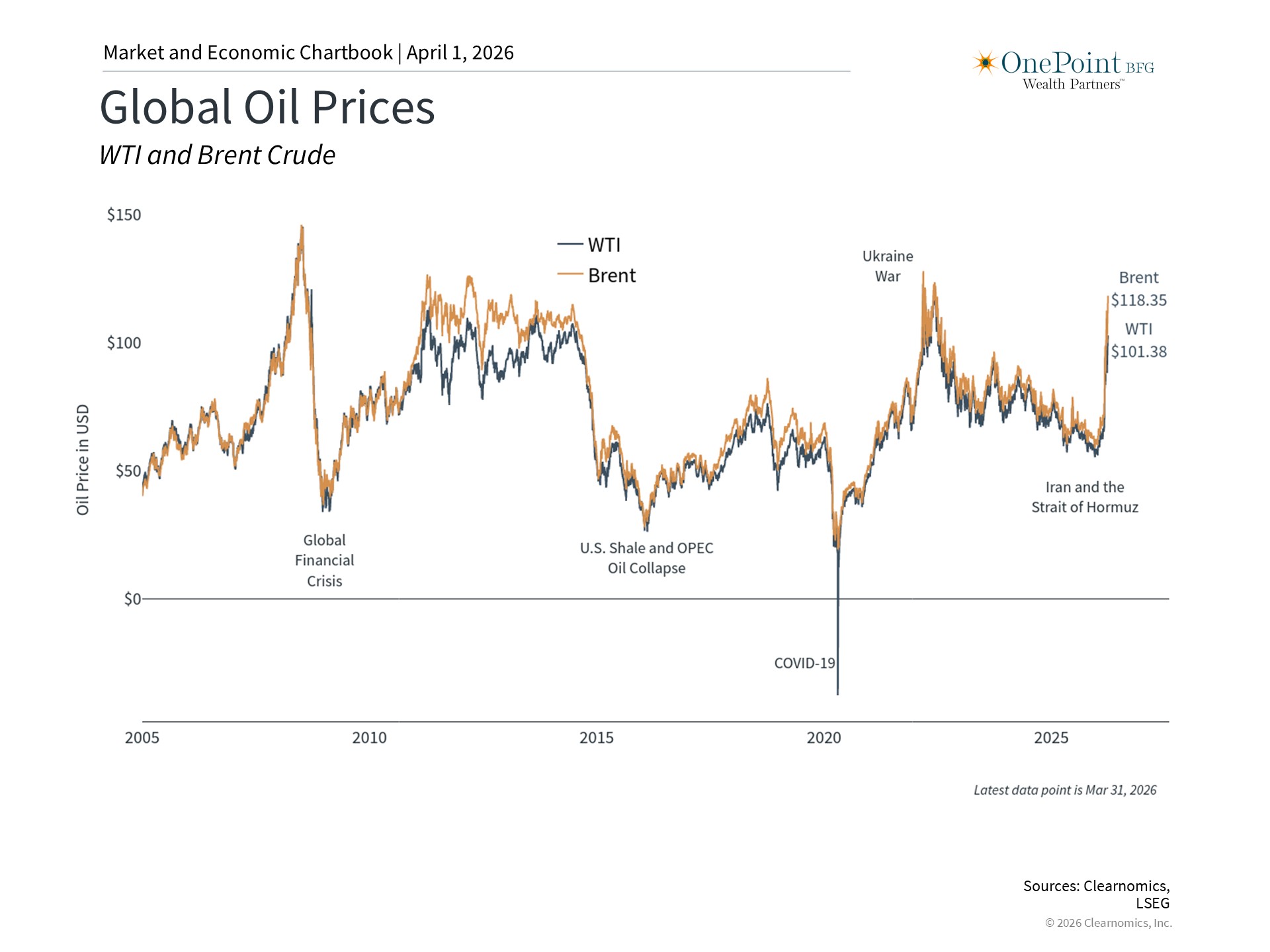
The most consequential market development of the first quarter was the escalation of conflict in the Middle East, which sent oil prices sharply higher. Disruptions to the Strait of Hormuz — a critical waterway that carries roughly 20% of global oil from the Persian Gulf to markets around the world — prompted production cuts among major oil-producing nations in the region. Brent crude ended the quarter at $118 per barrel, up over 94% year-to-date, while WTI crude surpassed $100, reaching the highest levels since the war in Ukraine began in 2022. Oil markets will likely remain sensitive to geopolitical developments, including any progress toward a potential ceasefire.
Rising fuel costs have a direct impact on consumers through higher prices at the gas pump, and they also filter through to the broader economy by raising the cost of goods and services. The national average price of gasoline reached $4 at the end of March, and diesel prices have risen substantially as well.
While these developments do affect household budgets, economists typically characterize such “supply-side shocks” as temporary when assessing the overall health of the economy. This is because oil prices tend to ease once the underlying geopolitical situation stabilizes. A relevant example occurred in 2022, when gasoline prices reached $5 before declining within months. While the current environment is uncomfortable, significant financial hardship is not expected for the average American household at present gasoline price levels.
History further demonstrates that geopolitical events, despite creating short-term instability, have not typically derailed markets over the long run. This was also evident following the U.S. operation in Venezuela in January, which surprised markets but had little lasting effect on investments. While the current situation continues to unfold and the humanitarian consequences are serious, investors who made dramatic portfolio adjustments in response to past geopolitical events frequently did so at inopportune moments.
Economic growth is moderating but remains constructive
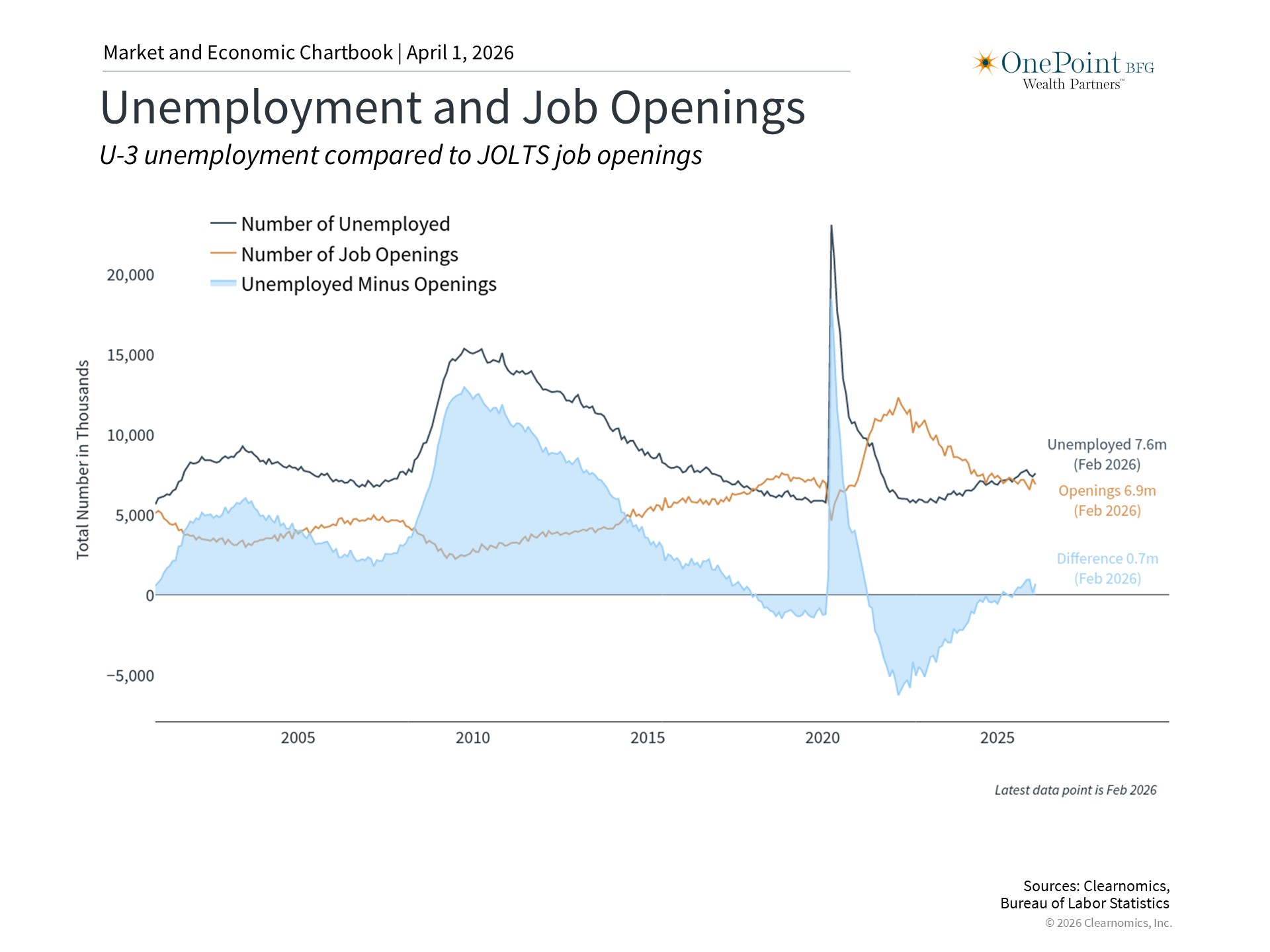
Volatile energy prices are just one component of a broader economic picture. Other indicators point to an economy that has moderated over the past year but remains fundamentally sound — this, after a prolonged stretch during which both investors and economists anticipated recessions that did not arrive.
The labor market continues to attract close attention, and recent payrolls data reveal that February job gains fell by 92,000 while the unemployment rate edged higher to 4.4%. Notably, job seekers now outnumber job openings for the first time in years. As recently as 2022, there were two job openings for every unemployed worker, reflecting an exceptionally tight labor market. That dynamic has since reversed.
Context is important when interpreting these trends. Fewer individuals are entering the workforce due to reduced immigration and an aging population. In effect, both the supply and demand sides of the labor market are cooling simultaneously, which has helped keep the unemployment rate near historically strong levels. Investors pay close attention to employment data because jobs directly influence household income, consumer confidence, and spending. Consumer spending accounts for more than two-thirds of GDP and has proven more resilient than many anticipated over recent quarters.
Sector performance has varied considerably
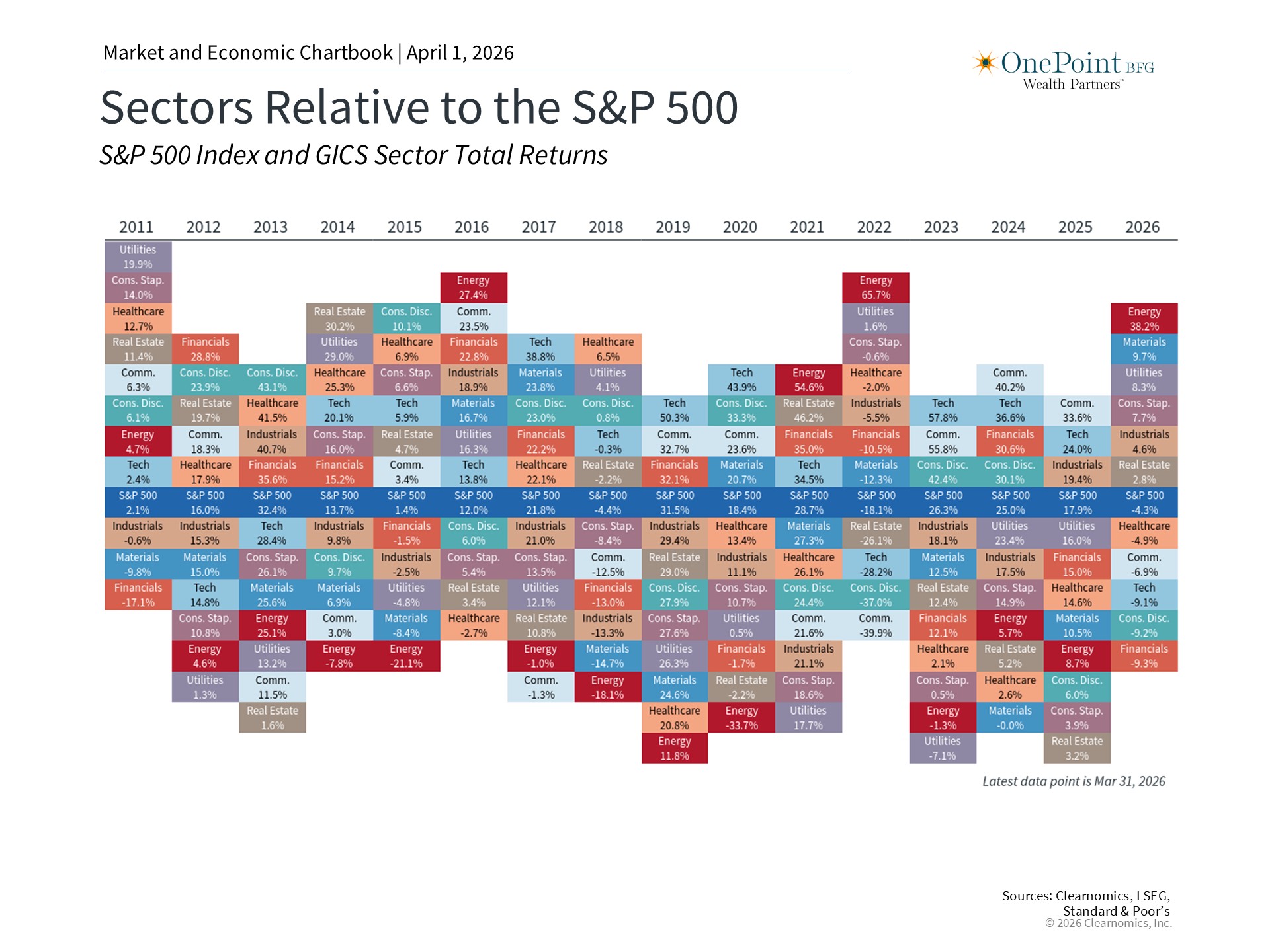
While the overall S&P 500 has experienced a pullback, performance at the sector level has varied widely. In fact, six of the eleven S&P 500 sectors are in positive territory for the year, and the gap between the best and worst performing sectors widened to nearly 50 percentage points during the first quarter.
The Energy sector has been the standout leader, gaining nearly 40% through the end of March, as higher oil prices are expected to boost revenues and attract further investment. Other sectors demonstrating strength include Consumer Staples, Utilities, Materials, and Industrials, all of which have benefited from a more risk-averse market environment. Many of these sectors are commonly viewed as “defensive,” as they tend to represent more stable businesses with consistent cash flows that are less sensitive to the economic cycle.
By contrast, the Information Technology sector has declined approximately 9%, and many of the large-cap stocks in the Magnificent 7 have underperformed. This represents a meaningful shift from recent years, when a small number of large technology companies accounted for the majority of market gains.
As always, it is important to maintain perspective on these moves. As the accompanying chart illustrates, sector leadership can rotate significantly based on evolving market and economic conditions. Energy was the top-performing sector in both 2021 and 2022, a period when technology-related stocks struggled, before that relationship reversed over the following three years. Just as with broader asset classes, predicting which sector will lead or lag in any given year is extremely difficult, which underscores why a well-diversified portfolio is better positioned to navigate a range of market environments.
The trade policy landscape continues to shift
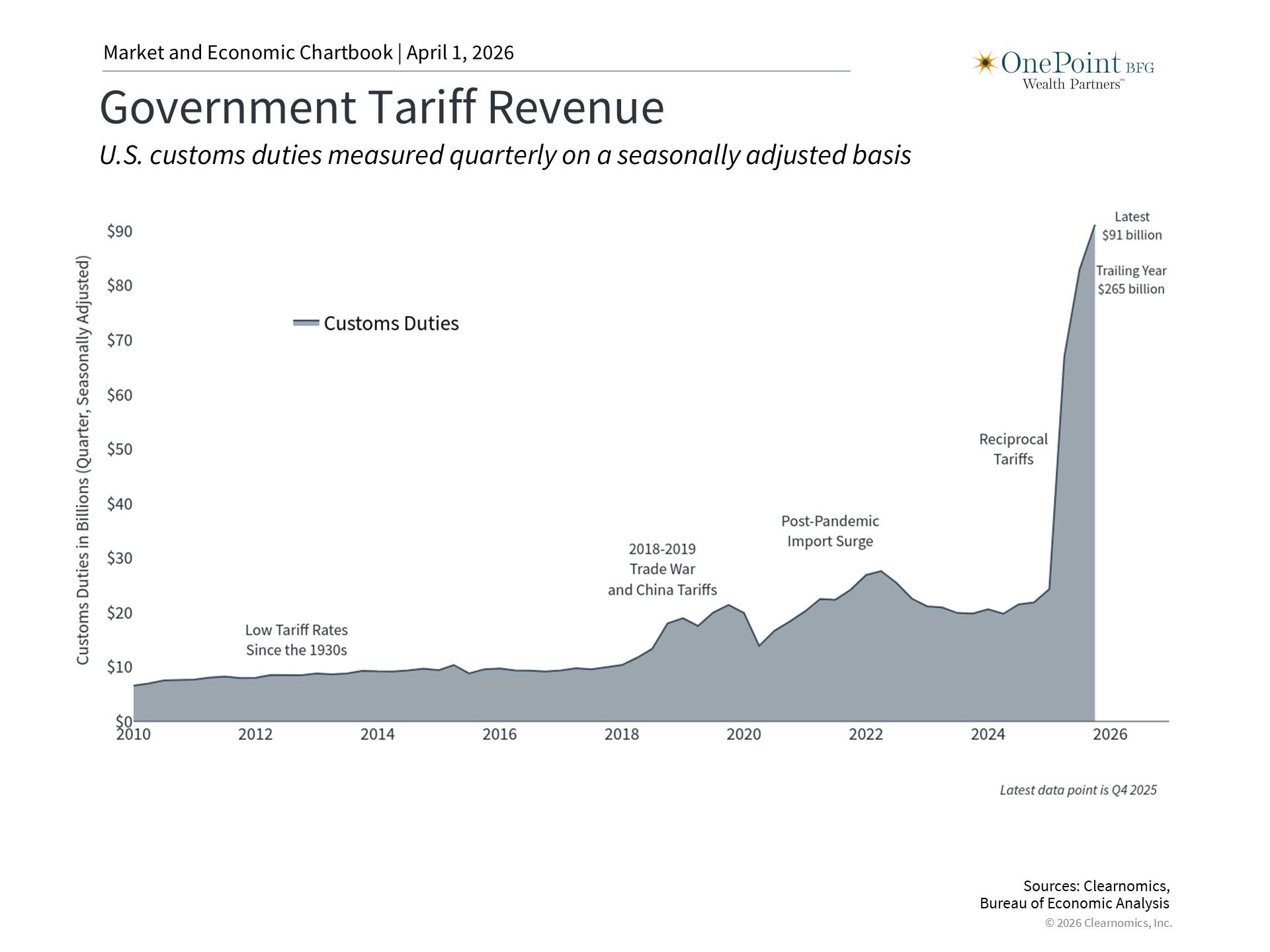
Trade policy also saw a significant development at the end of January, when the Supreme Court ruled 6-3 that the broad tariffs imposed under the International Emergency Economic Powers Act (IEEPA) were unlawful. The administration responded by implementing a temporary global import duty under a different statutory authority, Section 122 of the Trade Act of 1974. The administration also launched new Section 301 trade investigations in March, while approximately a dozen Section 232 investigations remain ongoing.
For investors, the primary takeaway is that while the legal framework underpinning tariffs has shifted, the broader direction of trade policy is likely to continue. Tariffs will likely continue to influence the economy through their effects on consumer prices, business costs, and investor confidence. That said, last year demonstrated that markets have the capacity to adapt to these kinds of policy changes over time. Regardless of how trade policy evolves through the rest of the year, staying invested and avoiding overreactions to policy developments remains the prudent approach.
The bottom line? The first quarter of 2026 has tested investors with geopolitical shocks, elevated oil prices, and broader economic uncertainty. Yet markets have demonstrated resilience, with well-diversified portfolios and thoughtful financial plans performing as intended. Investors are best served by maintaining their focus on long-term goals in the months ahead.
In uncertain markets, clarity matters.
If you’d like to discuss how these dynamics may impact your portfolio, we’re here to help.

Investment advisory and financial planning services offered through Bleakley Financial Group, LLC, an SEC registered investment adviser, doing business as OnePoint BFG Wealth Partners (herein referred to as “OnePoint BFG”).
OnePoint BFG Wealth Partners (“OnePoint BFG”) often uses Artificial Intelligence (“AI”) in the generation of reports such as the above. OnePoint BFG and its employees are bound by all applicable Firm policies and procedures when using AI. AI is subject to risks and limitations. OnePoint BFG has established policies and procedures to ensure all AI generated material goes through human review prior to dissemination. For additional information regarding AI, please refer to One Point BFG’s ADV 2A.
The opinions voiced in this material are for general information only and are not intended to provide specific advice or recommendations for any individual. The market and economic data is historical and is no guarantee of future results. All indices are unmanaged and may not be invested into directly. The information in this report has been prepared from data believed to be reliable, but no representation is being made as to its accuracy and completeness.
This commentary is for informational purposes only and is not meant to constitute a recommendation of any particular investment, security, portfolio of securities, transaction or investment strategy. No chart, graph, or other figure provided should be used to determine which securities to buy, sell or hold. No representation is made concerning the appropriateness of any particular investment, security, portfolio of securities, transaction or investment strategy. You should speak with your own financial professional before making any investment decisions.
Past performance is not indicative of future results. OnePoint BFG does not guarantee any specific outcome or profit. These disclosures cannot and do not list every conceivable factor that may affect the results of any investment or investment strategy. Risks will arise, and an investor must be willing and able to accept those risks, including the loss of principal.
Certain statements contained herein are statements of future expectations and other forward-lookinglooking statements that are based on opinions and assumptions that involve known and unknown risks and uncertainties that would cause actual results, performance or events to differ materially from those expressed or implied in such statements.
The economic forecasts set forth in this material may not develop as predicted and there can be no guarantee that strategies promoted will be successful. The fast price swings in commodities and currencies will result in significant volatility in an investor’s holdings. International investing involves special risks such as currency fluctuation and political instability and may not be suitable for all investors. These risks are often heightened for investments in emerging markets. The fast price swings in commodities and currencies will result in significant volatility in an investor’s holdings.
Advisors associated with OnePoint BFG may be: (1) registered representatives with, and securities offered through Purshe Kaplan Sterling Investments (“PKS”), Member FINRA/SIPC, (2) registered representatives with, and securities offered through PKS, Member FINRA/SIPC and investment advisor representatives of OnePoint BFG; or (3) solely investment advisor representatives of OnePoint BFG, and not affiliated with PKS. Investment advice offered through OnePoint BFG, a registered investment advisor and separate entity from PKS.
Copyright (c) 2026 Clearnomics, Inc. All rights reserved. The information contained herein has been obtained from sources believed to be reliable, but is not necessarily complete and its accuracy cannot be guaranteed. No representation or warranty, express or implied, is made as to the fairness, accuracy, completeness, or correctness of the information and opinions contained herein. The views and the other information provided are subject to change without notice. All reports posted on or via www.clearnomics.com or any affiliated websites, applications, or services are issued without regard to the specific investment objectives, financial situation, or particular needs of any specific recipient and are not to be construed as a solicitation or an offer to buy or sell any securities or related financial instruments. Past performance is not necessarily a guide to future results. Company fundamentals and earnings may be mentioned occasionally, but should not be construed as a recommendation to buy, sell, or hold the company's stock. Predictions, forecasts, and estimates for any and all markets should not be construed as recommendations to buy, sell, or hold any security--including mutual funds, futures contracts, and exchange traded funds, or any similar instruments. The text, images, and other materials contained or displayed in this report are proprietary to Clearnomics, Inc. and constitute valuable intellectual property. All unauthorized reproduction or other use of material from Clearnomics, Inc. shall be deemed willful infringement(s) of this copyright and other proprietary and intellectual property rights, including but not limited to, rights of privacy. Clearnomics, Inc. expressly reserves all rights in connection with its intellectual property, including without limitation the right to block the transfer of its products and services and/or to track usage thereof, through electronic tracking technology, and all other lawful means, now known or hereafter devised. Clearnomics, Inc. reserves the right, without further notice, to pursue to the fullest extent allowed by the law any and all criminal and civil remedies for the violation of its rights.
OP 26-0348


%20(1)-4.png?width=352&name=What%E2%80%99s%20Your%20OnePoint%20(1920%20x%20960%20px)%20(1)-4.png)