


The deal matters. But what happens before—and after—matters more.
A Liquidity Event Changes More Than Your Balance Sheet
Selling a business, going public, or recapitalizing is often framed as a financial milestone.
It is.
But it is also something else entirely.
A liquidity event forces a sudden shift:
- from concentrated wealth to diversified capital
- from active income to portfolio-driven income
- from building value to preserving and transferring it
And in that moment, the questions change.
Not just:
- What is the business worth?
But:
- What is this wealth actually for?
- How much is enough?
- What happens next?
Most planning frameworks acknowledge the complexity.
Few actually simplify it.
The Industry Gets the “What” Right—But Not the “When”
Across firms, there is broad agreement on what matters in a liquidity event:
- tax minimization
- estate and wealth transfer strategies
- diversification
- risk management
- philanthropic planning
These themes show up consistently in traditional guidance and planning checklists.
They are not wrong.
But they are incomplete.
Because the real advantage is not just what you do.
It is when you do it.
The Critical Window Most Business Owners Underutilize
One of the clearest insights across institutional planning frameworks is this: The 12–36 months before a liquidity event is where the most value is created.
During this period, business owners still have:
- control over ownership structure
- flexibility around valuation
- time to implement tax-aware strategies
- the ability to align personal, family, and financial goals
This is when:
- gifting strategies can be executed at lower valuations
- trust structures can be implemented efficiently
- charitable strategies can be positioned proactively
- equity decisions (including options) can be optimized
Once a deal is in motion, those opportunities narrow.
And in some cases, disappear entirely.
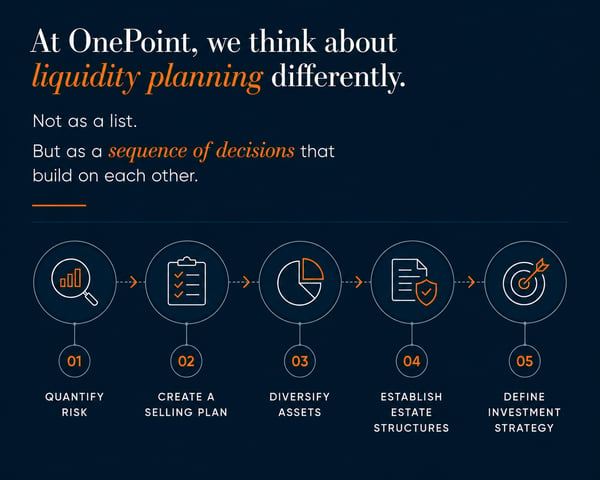
Liquidity Planning Is Not a Checklist. It’s a Sequence.
Many of the materials you’ll see in the market outline planning as a series of tasks:
- quantify risk
- create a selling plan
- diversify assets
- establish estate structures
- define investment strategy
All valid.
But when approached as a checklist, planning becomes fragmented.
At OnePoint, we think about liquidity planning differently.
Not as a list.
But as a sequence of decisions that build on each other.
A Planning-Led Framework for Liquidity Events
1. Define Life After Liquidity Before Structuring the Event
Most planning starts with taxes.
We start with clarity.
Before structuring wealth, we define:
- lifestyle expectations
- cash flow needs
- family dynamics and expectations
- long-term goals and legacy priorities
Because without that, optimization lacks direction.
Many business owners are used to steady income tied to their business.
Post-liquidity, that disappears.
Replacing it requires intentional planning around:
- portfolio income
- liquidity reserves
- spending strategy
This is one of the most underestimated transitions—and one of the most important to get right.
2. Align Tax and Wealth Transfer Strategy Early
The materials you shared consistently reinforce one point:
Pre-liquidity planning creates meaningful tax and transfer advantages.
Examples include:
- gifting interests before valuation increases
- using trust structures to transfer appreciation
- implementing charitable strategies before a taxable event
- evaluating how equity compensation is exercised and taxed
These are not just technical strategies.
They are timing strategies.
And when executed early, they can significantly influence:
- after-tax proceeds
- multigenerational wealth transfer
- long-term control of assets
3. Coordinate Across Advisors—Not Around Them
Liquidity events require multiple specialists:
- tax advisors
- estate attorneys
- M&A professionals
- investment managers
Most firms assemble the team.
Few truly coordinate it.
Without coordination:
- strategies can conflict
- timing can be misaligned
- opportunities can be missed
The value is not just expertise.
It is orchestration.
At OnePoint, we act as that coordinating layer—ensuring every decision fits into a single, cohesive plan.
4. Prepare for the Reality of Post-Liquidity Life
Traditional planning materials often include post-event checklists:
- diversify assets
- create an investment plan
- establish monitoring processes
- review estate documents
All necessary.
But they understate the magnitude of the transition.
After liquidity, business owners must:
- move from concentrated risk to diversified exposure
- shift from active income to portfolio income
- define new decision-making frameworks
- manage increased visibility and risk
There is also a personal dimension:
- identity shifts
- changes in daily structure
- new expectations from family
These are not secondary considerations.
They directly influence financial decisions.
From Transaction to Transformation
A liquidity event is often treated as a one-time transaction.
But in reality, it is one of the few moments where everything can be restructured:
- your balance sheet
- your tax exposure
- your estate plan
- your long-term financial trajectory
Handled reactively, it becomes a missed opportunity.
Handled intentionally, it becomes a turning point.
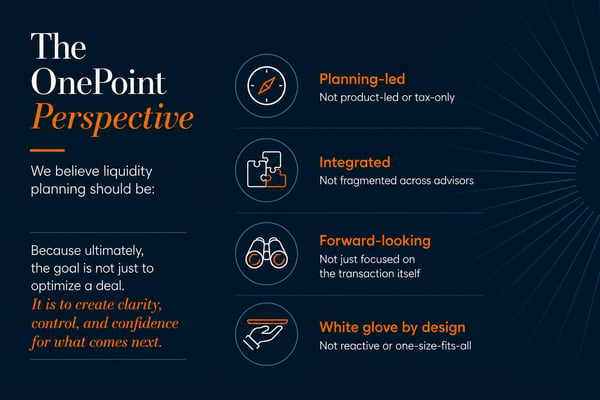
The OnePoint Perspective
We believe liquidity planning should be:
Planning-led
Not product-led or tax-only
Integrated
Not fragmented across advisors
Forward-looking
Not just focused on the transaction itself
White glove by design
Not reactive or one-size-fits-all
Because ultimately, the goal is not just to optimize a deal.
It is to create clarity, control, and confidence for what comes next.
Final Thought
You will likely experience a liquidity event once.
The outcome is not defined by the deal alone.
It is defined by:
- the planning that comes before it
- the decisions made during it
- and the discipline applied after it
That is where long-term wealth is shaped.
The decisions you make before the deal will define everything that comes after.

Investment advisory and financial planning services offered through Bleakley Financial Group, LLC, an SEC registered investment adviser, doing business as OnePoint BFG Wealth Partners (herein referred to as “OnePoint BFG”). For more information regarding OnePoint BFG including important disclosures, please visit https://adviserinfo.sec.gov/.
The third-party information contained herein is provided for informational and discussion purposes only. OnePoint BFG does not represent this third-party information as its own. While OnePoint BFG has gathered this information from sources deemed to be reliable, OnePoint BFG has not reviewed or verified any information input by your financial professional or that of the third-party source, nor can OnePoint BFG guarantee the completeness or accuracy of this data.
OnePoint BFG does not offer legal or tax advice. This document is not a substitute for the advice of a qualified attorney or tax professional. You should not take any action based solely on the information provided on this report without seeking legal counsel from a licensed attorney or tax professional in your jurisdiction. No attorney-client relationship is formed by your use of this document.
OnePoint BFG often uses Artificial Intelligence (“AI”) in the generation of marketing and advertising and has established policies to ensure all AI generated material goes through human review prior to dissemination. This communication has been provided for general informational and discussion purposes only, and should not be considered as investment, legal or tax advice or as a recommendation. OnePoint BFG does not represent any third-party information used as its own. Please contact your legal counsel or tax advisor to recommend the application of this general information to any particular situation or prepare an instrument chosen to implement the design discussed herein.
This communication has been provided for informational purposes only and should not be considered as investment, legal or tax advice or as a recommendation. This material provides general information only. OnePoint BFG does not offer legal or tax advice. Please contact legal counsel or your tax advisor to recommend the application of this general information to any particular situation or prepare an instrument chosen to implement the design discussed herein. Circular 230 notice: To ensure compliance with requirements imposed by the IRS, this notice is to inform you that any tax advice included in this communication, including any attachments, is not intended or written to be used, and cannot be used, for the purpose of avoiding any federal tax penalty or promoting, marketing, or recommending to another party any transaction or matter.
OP 26-0483