


When considering the stock market, most investors naturally gravitate toward broad indices such as the S&P 500 or the Dow Jones Industrial Average. While these are useful reference points, examining the individual sectors that comprise each index can offer valuable additional insight. The S&P 500, for example, is made up of 11 distinct sectors, each with its own characteristics and sensitivity to economic conditions and geopolitical events. Understanding these differences plays a meaningful role in portfolio construction, diversification, and long-term financial planning.
In the current environment, the gap between the top and bottom performing sectors has grown to more than 40 percentage points this year — a notable development shaped by the ongoing conflict in the Middle East, fluctuations in oil prices, and the rapidly evolving landscape around artificial intelligence.
The S&P 500 has also experienced its first pullback of more than 5% from its all-time high, even as 6 of the 11 sectors remain positive on the year. This is possible because the index is not equally weighted — Technology currently accounts for nearly one-third of the index, while Energy and Utilities represent just 3.5% and 2.5%, respectively. History, while not a guarantee of future results, has repeatedly shown that conditions can shift rapidly and that markets often recover when least expected.
Though the market dynamics of recent months have been significant, sector-level variation is a recurring feature of financial markets every year. Taking a longer-term perspective, many sectors have delivered strong returns over the past several years, often in ways that caught investors off guard. This is a reminder that maintaining balance across sectors is just as important as diversifying across asset classes. With that in mind, what context is needed to make sense of the recent sector rotation and market pullback?
Geopolitical uncertainty has propelled the energy sector higher
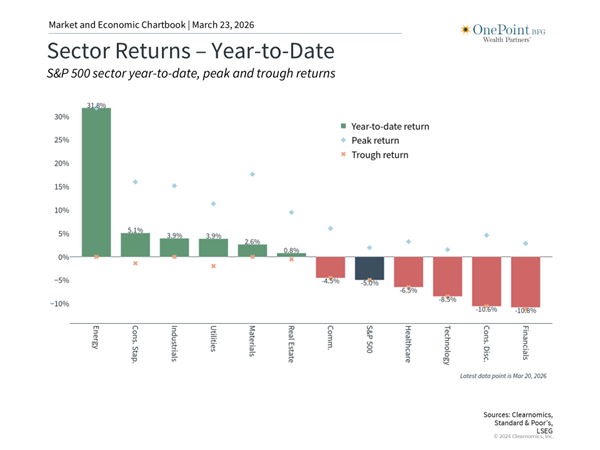
The energy sector has been a standout beneficiary of geopolitical risk in 2026, advancing roughly 30% year-to-date. This strong showing has been fueled by a sharp increase in oil prices, with Brent crude trading above $100 per barrel as tensions in the Middle East have intensified. The situation continues to evolve, which may sustain market volatility. Historically, periods of geopolitical conflict have tended to push energy stocks higher, and the current environment is consistent with that pattern.
A useful historical parallel is 2022, when Russia's invasion of Ukraine helped the energy sector gain 65.7% for the full year, even as the broader S&P 500 declined 18%. The year prior, energy returned 54.6% as the economy recovered from the pandemic. While broad markets eventually rebounded from both episodes, these examples illustrate how energy stocks can serve as a counterweight during periods of global uncertainty.
This year, oil prices initially rose following the blockage of the Strait of Hormuz, which prompted several Middle Eastern nations to reduce oil and gas output. More recent developments have seen attacks directed at energy production infrastructure. Higher oil prices benefit producers directly by increasing revenues and creating incentives for additional investment and exploration.
At the same time, elevated oil prices can weigh on the broader economy by increasing costs for consumers, businesses, and many other sectors. This dynamic explains why the same shock that lifts energy stocks can simultaneously pressure transportation, consumer spending, and corporate profit margins across other industries.
Over the long run, however, there are reasons to avoid excessive pessimism about elevated oil prices. From 2011 to 2014, oil prices remained near $100 per barrel, yet the economy continued to expand and equity markets sustained their upward trajectory. Economists typically characterize these episodes as "supply-side shocks" that are temporary in nature, as production tends to be restored and alternative suppliers step in over time.
The United States, for instance, has been the world's largest oil producer for six consecutive years, with output now surpassing 13.7 million barrels per day. The U.S. is widely regarded as a "swing producer" whose ability to ramp up production can help offset shortfalls elsewhere, moderating prices over time and reducing the economy's exposure to foreign supply disruptions.
The rise of AI has introduced new questions for technology companies
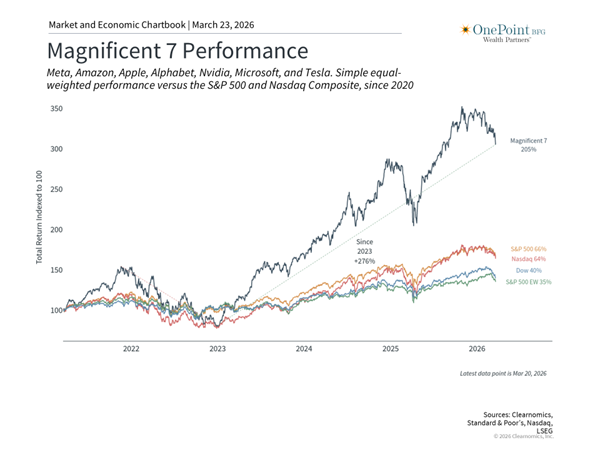
Over recent years, AI-driven stocks led the market higher, generating substantial gains across sectors including Information Technology, Communication Services, and Consumer Discretionary. The sustained outperformance of these sectors — including the so-called Magnificent 7 — has resulted in greater index concentration and heightened sensitivity to a relatively small number of companies.
More recently, however, the narrative has begun to shift. While these companies continue to report solid earnings, other sectors — including Energy, Industrials, Utilities, Materials, and Consumer Staples — have demonstrated stronger relative performance over the past year. Many of these groups are considered more "defensive" in nature and have found favor in the current market environment.
Part of the changing story around technology reflects growing questions about how AI will reshape existing software business models. Some have referred to this as the "SaaS-pocalypse" — the notion that AI tools could disrupt traditional software-as-a-service (SaaS) companies. Whether or not these concerns ultimately prove valid remains an open debate, but they have already contributed to a reassessment of technology sector valuations.
This rotation does not imply that technology stocks have lost their relevance. Rather, it underscores how swiftly market leadership can change. Investors should therefore be thoughtful about becoming overly concentrated in any single sector, regardless of how compelling the growth narrative may appear. Ultimately, the goal of a portfolio is not to chase the highest-performing index, sector, or individual stocks, but to generate healthy returns across market cycles that support long-term financial plans.
Defensive sectors and broad diversification have helped support portfolios
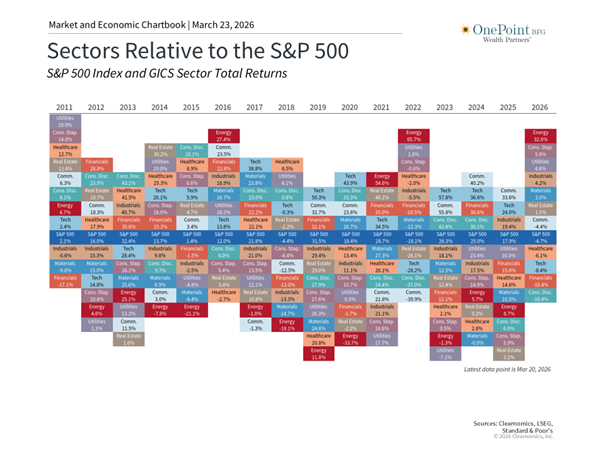
As uncertainty climbed over recent months, investor attention turned to traditionally defensive sectors such as Utilities, Consumer Staples, and, to a lesser degree, Health Care. This defensive positioning had been building before the most recent escalation in the Middle East, suggesting that investors were already adopting a more cautious stance in response to concerns surrounding AI.
Defensive sectors tend to outperform during periods of heightened uncertainty and market volatility — not because these companies are suddenly delivering exceptional financial results, but because their cash flows are generally more stable and less dependent on a robust economic cycle. Utilities continue to collect payments, consumers continue to purchase everyday necessities, and healthcare remains indispensable regardless of geopolitical developments. These sectors also tend to offer higher average dividend yields. This relative predictability is what makes them more appealing when markets grow concerned about growth or inflation.
A related term that has emerged for stocks considered less vulnerable to AI disruption is "heavy assets, low obsolescence," or HALO. These companies tend to be defensive in character, producing physical goods or relying on manufacturing processes that are not easily displaced by new technological developments.
As with asset classes, accurately predicting which sector will lead or lag in any given year is extremely difficult. The top-performing sector one year frequently finds itself near the bottom the following year — technology's recent challenges, for example, follow an extended period of market dominance. This inherent unpredictability reinforces the importance of maintaining broad sector exposure.
A well-diversified portfolio that spans cyclical sectors such as energy, growth-oriented sectors such as technology, and defensive sectors such as utilities and consumer staples is better equipped to navigate a range of market environments. Rather than attempting to time sector rotations — which is just as difficult and counterproductive as timing the overall market — investors are better served by holding a balanced portfolio that can participate in gains across different areas of the economy while managing overall risk.
The bottom line? The S&P 500's performance this year reinforces that maintaining sector balance is a foundational principle of long-term investing. Broad exposure across different parts of the market is the most effective way to keep portfolios aligned with long-term financial goals.
If you’re thinking about your own approach, we’d welcome a conversation.

Investment advisory and financial planning services offered through Bleakley Financial Group, LLC, an SEC registered investment adviser, doing business as OnePoint BFG Wealth Partners (herein referred to as “OnePoint BFG”).
The opinions voiced in this material are for general information only and are not intended to provide specific advice or recommendations for any individual. The market and economic data is historical and is no guarantee of future results. All indices are unmanaged and may not be invested into directly. The information in this report has been prepared from data believed to be reliable, but no representation is being made as to its accuracy and completeness.
This commentary is for informational purposes only and is not meant to constitute a recommendation of any particular investment, security, portfolio of securities, transaction or investment strategy. No chart, graph, or other figure provided should be used to determine which securities to buy, sell or hold. No representation is made concerning the appropriateness of any particular investment, security, portfolio of securities, transaction or investment strategy. You should speak with your own financial professional before making any investment decisions.
Past performance is not indicative of future results. OnePoint BFG does not guarantee any specific outcome or profit. These disclosures cannot and do not list every conceivable factor that may affect the results of any investment or investment strategy. Risks will arise, and an investor must be willing and able to accept those risks, including the loss of principal.
Certain statements contained herein are statements of future expectations and other forward looking statements that are based on opinions and assumptions that involve known and unknown risks and uncertainties that would cause actual results, performance or events to differ materially from those expressed or implied in such statements.
The economic forecasts set forth in this material may not develop as predicted and there can be no guarantee that strategies promoted will be successful. The fast price swings in commodities and currencies will result in significant volatility in an investor’s holdings. International investing involves special risks such as currency fluctuation and political instability and may not be suitable for all investors. These risks are often heightened for investments in emerging markets. The fast price swings in commodities and currencies will result in significant volatility in an investor’s holdings.
Advisors associated with OnePoint BFG may be: (1) registered representatives with, and securities offered through Purshe Kaplan Sterling Investments (“PKS”), Member FINRA/SIPC, (2) registered representatives with, and securities offered through PKS, Member FINRA/SIPC and investment advisor representatives of OnePoint BFG; or (3) solely investment advisor representatives of OnePoint BFG, and not affiliated with PKS. Investment advice offered through OnePoint BFG, a registered investment advisor and separate entity from PKS.
Copyright (c) 2026 Clearnomics, Inc. All rights reserved. The information contained herein has been obtained from sources believed to be reliable, but is not necessarily complete and its accuracy cannot be guaranteed. No representation or warranty, express or implied, is made as to the fairness, accuracy, completeness, or correctness of the information and opinions contained herein. The views and the other information provided are subject to change without notice. All reports posted on or via www.clearnomics.com or any affiliated websites, applications, or services are issued without regard to the specific investment objectives, financial situation, or particular needs of any specific recipient and are not to be construed as a solicitation or an offer to buy or sell any securities or related financial instruments. Past performance is not necessarily a guide to future results. Company fundamentals and earnings may be mentioned occasionally, but should not be construed as a recommendation to buy, sell, or hold the company's stock. Predictions, forecasts, and estimates for any and all markets should not be construed as recommendations to buy, sell, or hold any security--including mutual funds, futures contracts, and exchange traded funds, or any similar instruments. The text, images, and other materials contained or displayed in this report are proprietary to Clearnomics, Inc. and constitute valuable intellectual property. All unauthorized reproduction or other use of material from Clearnomics, Inc. shall be deemed willful infringement(s) of this copyright and other proprietary and intellectual property rights, including but not limited to, rights of privacy. Clearnomics, Inc. expressly reserves all rights in connection with its intellectual property, including without limitation the right to block the transfer of its products and services and/or to track usage thereof, through electronic tracking technology, and all other lawful means, now known or hereafter devised. Clearnomics, Inc. reserves the right, without further notice, to pursue to the fullest extent allowed by the law any and all criminal and civil remedies for the violation of its rights.
OP 26-0306